
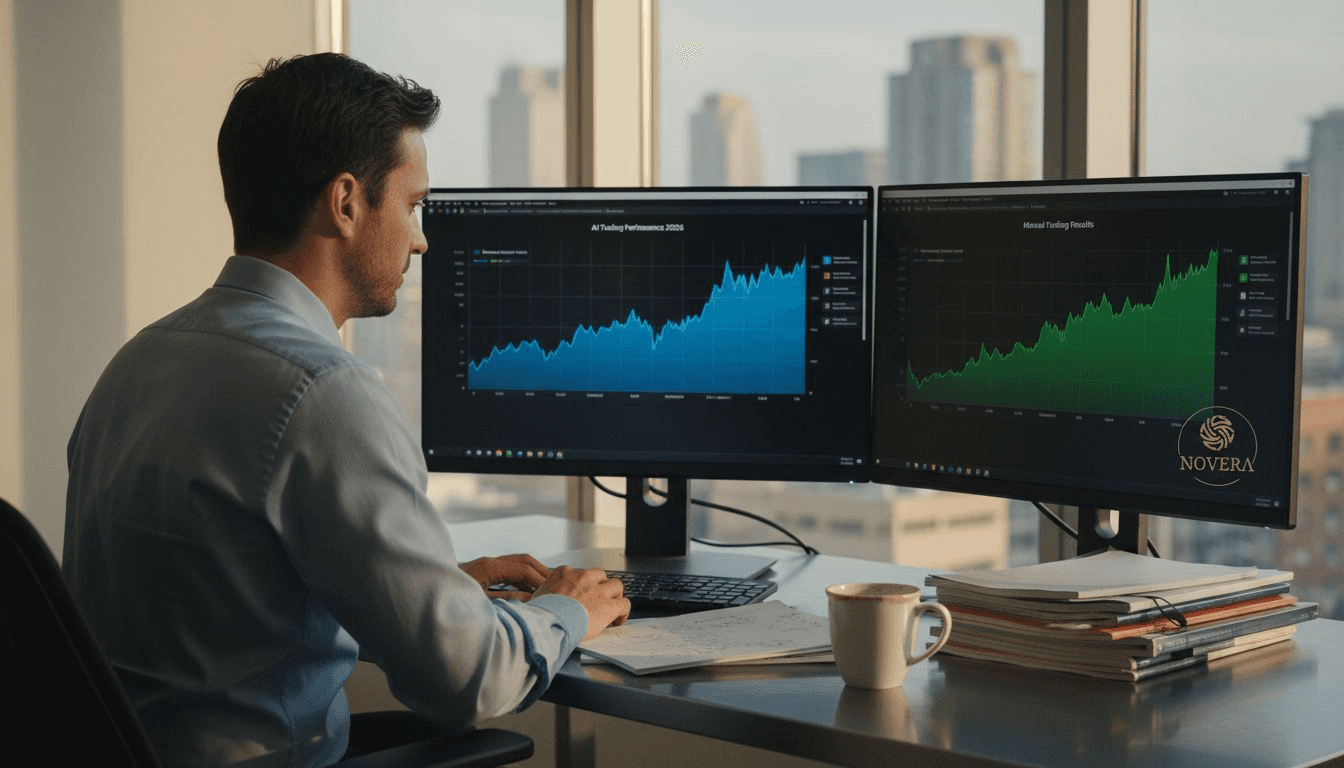
Most traders judge their success by profits alone, missing critical insights that separate consistent winners from those who lose gains to poor risk management. Trading performance benchmarks provide objective criteria tailored to your style and goals, revealing weaknesses in strategy execution that simple profit tracking never exposes. This guide walks you through selecting the right benchmarks, understanding key metrics, and using specialized tools to boost consistency and profitability in 2026.
Table of Contents
- How To Select Trading Performance Benchmarks: Key Criteria
- Essential Trading Performance Metrics Explained
- Performance Benchmarks By Trading Style & Strategy
- Evaluating And Improving Trading Performance Using Benchmarks
- Top Trading Platforms And Analytics Tools For Benchmark Tracking
- Summary Comparison Of Trading Performance Benchmarks
- Situational Benchmark Picks For German Traders
- Unlock Your Trading Potential With Novera's Performance Tools
- Frequently Asked Questions About Trading Performance Benchmarks
Key takeaways
| Point | Details | |-------|---------|| | Benchmark selection must align with trading style and risk tolerance | Different strategies require different metrics for accurate performance evaluation | | Key metrics include win rate, Sharpe ratio, max drawdown, and profit factor | These provide comprehensive insight beyond simple profit/loss statements | | AI trading benchmarks significantly outperform manual trading | Returns of 48-169% versus 8-15% demonstrate measurable performance gaps | | Multi-metric evaluation improves strategy refinement and risk control | Tracking 10-12 core metrics prevents analysis paralysis while capturing essential data | | Specialized platforms enhance benchmark tracking and consistency | Automated journals reduce manual effort and improve actionable feedback delivery |
How to select trading performance benchmarks: key criteria
Choosing relevant benchmarks starts with understanding your trading timeframes and style. Scalpers need different metrics than swing traders, and using inappropriate benchmarks creates misleading performance pictures that waste time and capital.
Risk-adjusted metrics matter more than raw returns for robust evaluation. A 50% annual return with 40% drawdown signals unstable strategy execution, while 25% returns with 10% drawdown indicates sustainable performance. Prioritize benchmarks by these criteria:
- Trading relevance: metrics directly tied to your strategy type and market conditions
- Risk focus: measurements that capture downside exposure and volatility impact
- Consistency measurement: indicators showing performance stability across market cycles
- Data accessibility: metrics you can calculate easily from broker statements and platforms
- Industry adoption: widely used standards that enable peer comparison and validation
Benchmark clarity accelerates decision making and simplifies automation integration. Complex proprietary metrics slow analysis and reduce actionable insights. Avoid overly sophisticated measurements that lack industry recognition or require extensive manual calculation.
Pro Tip: Start with five core metrics (win rate, Sharpe ratio, max drawdown, profit factor, expectancy) before expanding to secondary indicators like Sortino ratio or Calmar ratio once you establish consistent tracking habits.
Essential trading performance metrics explained
Understanding core metrics transforms vague performance impressions into concrete improvement targets. Each metric reveals specific strategy strengths and weaknesses that guide tactical adjustments.
Win rate measures the percentage of profitable trades against total trades executed. Performance Metrics for Professional Traders reveals win rates vary significantly by trading style, with scalpers targeting 50-60% and swing traders aiming for 40-50%. Higher win rates provide psychological comfort but mean nothing without considering average win versus loss sizes.
Risk-reward ratio compares average profit per winning trade to average loss per losing trade. Sustainable strategies maintain ratios around 2:1 to 3:1, meaning wins are two to three times larger than losses. This metric explains why traders with 40% win rates can still generate profits.
Sharpe ratio evaluates risk-adjusted returns by dividing excess returns above the risk-free rate by return volatility. Values above 1.5 indicate strong performance, while readings below 1.0 suggest excessive risk for the returns generated. This metric helps compare strategies with different volatility profiles.
Max drawdown tracks the largest peak-to-trough decline in account value during a specific period. Professional traders target drawdowns under 10-20% to maintain capital stability and psychological resilience. Larger drawdowns require exponentially greater returns to recover original capital levels.
Profit factor divides gross profits by gross losses across all trades. Readings above 1.5 signal profitable strategies, while values below 1.2 indicate marginal performance vulnerable to small execution changes or market shifts.
Expectancy calculates the average amount you can expect to win or lose per trade. Calculate it using: (Win Rate × Average Win) minus (Loss Rate × Average Loss). Positive expectancy confirms edge existence, while negative values demand immediate strategy revision.
Tracking these trading performance metrics systematically reveals patterns that single-metric analysis misses. Start by calculating each metric monthly, then adjust tracking frequency based on trade volume and strategy complexity.
Performance benchmarks by trading style & strategy
Benchmark targets vary dramatically across trading approaches, making style-specific comparison essential for accurate performance evaluation. Using day trading benchmarks to judge swing trading results creates false performance narratives.
AI trading systems deliver returns of 48-169% versus manual trading's 8-15%, demonstrating measurable performance gaps in 2026. Win rates show similar disparities, with AI systems achieving 70-85% success rates compared to manual traders' 45-52%. Sharpe ratios further highlight this gap: AI systems post 2.3-4.4 readings while manual approaches typically generate 0.6-1.2.

| Trading Style | Win Rate | Sharpe Ratio | Max Drawdown | Profit Factor |
|---|---|---|---|---|
| AI Trading | 70-85% | 2.3-4.4 | 8-15% | 2.5-3.8 |
| Manual Trading | 45-52% | 0.6-1.2 | 15-25% | 1.2-1.8 |
| Day Trading | 45-55% | 0.8-1.5 | 12-20% | 1.3-2.0 |
| Swing Trading | 40-50% | 1.0-1.8 | 15-25% | 1.5-2.2 |
| Algorithmic | 60-75% | 1.5-2.3 | 10-18% | 2.0-3.0 |
Day traders focus on high-frequency opportunities with win rates around 45-55%. Lower win rates remain viable when paired with disciplined risk-reward ratios exceeding 2:1. Swing traders accept lower win rates (40-50%) in exchange for larger average wins that offset fewer successful trades.
Elite algorithmic trading systems demonstrate Sharpe ratios between 1.5-2.3, max drawdowns under 18%, and profit factors exceeding 2.0. These benchmarks reflect systematic execution advantages and emotion-free decision making that manual traders struggle to match consistently.
Trend following portfolios delivered 9.34% monthly returns in early 2026, showcasing the power of systematic approaches during sustained directional moves. However, these strategies suffer during choppy markets, emphasizing the importance of matching benchmarks to current market conditions.
Choosing appropriate benchmarks requires honest assessment of your trading frequency, holding periods, and automation level. Compare your metrics against AI trading benchmarks if you use algorithms, or against manual trading style benchmarks for discretionary approaches.
Evaluating and improving trading performance using benchmarks
Applying benchmark data reveals specific strategy weaknesses that single-metric analysis overlooks. Combined metric evaluation provides deeper insight than isolated measurements, helping you identify whether problems stem from entry timing, position sizing, or exit execution.
Prioritize tracking 10-12 core metrics to avoid analysis paralysis while capturing essential performance dimensions. More metrics do not equal better insights when excess data creates confusion instead of clarity.
Follow this evaluation sequence:
- Calculate current metrics across your last 50-100 trades for statistical significance
- Compare results against style-specific benchmarks to identify gaps
- Rank weaknesses by impact on overall profitability and consistency
- Focus improvement efforts on the top two gaps before addressing others
- Implement changes gradually while continuing to track benchmark progress
- Review updated metrics monthly to confirm improvements stick
Professional traders reduce position size by 20% when Sharpe ratio drops from 1.8 to 1.3, demonstrating how benchmark monitoring triggers tactical adjustments. This response prevents small performance slips from becoming major drawdown events.
Recognize that strategies with lower win rates but higher expectancy often outperform high win rate approaches over time. A 40% win rate with 3:1 risk-reward generates better returns than 60% win rate with 1:1 risk-reward, yet traders gravitate toward higher win rates due to psychological comfort.
"Consistent profitability comes from managing losing trades, not maximizing winning ones. Your worst loss defines your survival, not your best win."
Interpret drawdown and profit factor alongside returns for complete performance pictures. High returns with deep drawdowns indicate unsustainable risk taking, while modest returns with shallow drawdowns suggest room for calculated position size increases.
Implement iterative benchmark reviews for ongoing improvement rather than one-time analysis. Monthly reviews for active traders and quarterly reviews for swing traders provide sufficient feedback frequency without creating obsessive monitoring habits. Use strategy refinement with benchmarks to systematize this process and maintain improvement momentum.
Pro Tip: Create a simple benchmark dashboard showing your metrics versus targets using conditional formatting. Green for meeting targets, yellow for close, red for significant gaps. This visual approach accelerates pattern recognition and keeps improvement efforts focused.
Top trading platforms and analytics tools for benchmark tracking
Effective benchmark tracking requires platforms that automate calculation and present insights clearly. Manual spreadsheet tracking works initially but becomes unsustainable as trade volume increases and metric complexity grows.
Trading platforms achieve median Composite Lab Performance Scores around 4.21/5 across 35+ evaluated systems in 2026. Top platforms score 4.7-5.0 but typically cost around $303 monthly, putting them beyond most retail trader budgets.
Retail trader costs range from $22 to $303 monthly depending on features and data access. Finance apps retain only 4.2% of users by day 30, highlighting how poor usability and unclear insights drive abandonment despite initial interest.
| Platform Type | Monthly Cost | Performance Score | Key Features | Best For |
|---|---|---|---|---|
| Premium Trading | $250-$303 | 4.7-5.0 | Real-time data, advanced analytics | Professional traders |
| Mid-Tier Tools | $80-$150 | 4.0-4.5 | Delayed data, basic metrics | Active retail traders |
| Entry Tools | $22-$50 | 3.5-4.2 | Essential tracking, manual input | Beginning traders |
| Specialized Journals | $30-$100 | 4.3-4.8 | Automated metrics, AI insights | Improvement-focused traders |
Prioritize these features when selecting trading analytics tools:
- Low latency data feeds for accurate entry and exit recording
- High throughput handling for active traders executing 20+ trades daily
- Automation of metric calculation to eliminate manual errors
- Automated trade journaling that captures setup, execution, and emotional state
- Customizable benchmark reporting aligned to your specific strategy
Novera Trading's TradeJournal automates benchmark tracking across all essential metrics while providing AI-powered performance insights. The platform integrates directly with major brokers, eliminating manual trade entry and calculation errors that plague spreadsheet approaches.
Cost versus benefit analysis favors specialized tools over premium trading platforms for most retail traders. Paying $303 monthly for features you never use wastes capital better deployed in trading accounts, while focused tools delivering core functionality at $30-$100 monthly provide superior value.
Summary comparison of trading performance benchmarks
This comprehensive comparison synthesizes key benchmark metrics by trading style and tool performance scores, enabling quick decision making about appropriate targets and tracking solutions.
| Metric | AI Trading | Manual Trading | Day Trading | Swing Trading | Algo Trading |
|---|---|---|---|---|---|
| Win Rate | 70-85% | 45-52% | 45-55% | 40-50% | 60-75% |
| Annual Returns | 48-169% | 8-15% | 15-30% | 12-25% | 30-80% |
| Sharpe Ratio | 2.3-4.4 | 0.6-1.2 | 0.8-1.5 | 1.0-1.8 | 1.5-2.3 |
| Max Drawdown | 8-15% | 15-25% | 12-20% | 15-25% | 10-18% |
| Profit Factor | 2.5-3.8 | 1.2-1.8 | 1.3-2.0 | 1.5-2.2 | 2.0-3.0 |
| Platform Cost | $80-$250 | $22-$100 | $50-$150 | $30-$100 | $150-$303 |
| Tool Performance | 4.5-4.8 | 4.0-4.5 | 4.2-4.7 | 4.0-4.5 | 4.5-5.0 |
AI versus manual trading benchmark disparities remain substantial in 2026, with AI systems demonstrating 161% higher maximum returns and nearly double the win rates. These gaps reflect systematic execution advantages rather than strategy superiority, suggesting manual traders can close performance gaps through disciplined adherence to rules and risk management.
Strategy-specific benchmark suitability notes:
- Scalpers require platforms with sub-100ms latency and high throughput to capture accurate execution data
- Swing traders benefit most from weekly/monthly metric aggregation rather than trade-by-trade analysis
- Algorithmic traders need robust backtesting integration to validate benchmark assumptions before live deployment
- Position traders should emphasize Sharpe ratio and max drawdown over win rate given lower trade frequency
Visual assessment of this data helps traders quickly identify whether their current performance aligns with style-appropriate benchmarks or requires strategic adjustment. Significant gaps (more than 20% below benchmark targets) demand immediate attention, while minor variations allow continued strategy execution with periodic monitoring.
Situational benchmark picks for German traders
Tailored benchmark selection accounts for individual trader profiles, goals, and constraints rather than applying universal standards that ignore personal circumstances and market access.
Scalpers and day traders prioritize high win rates (50-60%) and risk-reward ratios around 2:1 given their high trade frequency and short holding periods. Low latency platforms become essential for accurate entry and exit recording at millisecond precision. Max drawdown targets should stay under 15% since rapid trading creates multiple opportunities for recovery.
Swing and position traders focus on Sharpe ratios exceeding 1.5 and max drawdowns under 20% rather than win rate optimization. Lower trade frequency means each trade carries more weight, making risk-adjusted returns more important than success percentage. Automated journals help maintain consistent tracking despite weeks between trades.
Algorithmic and AI traders target 48-169% annual returns with 70-85% win rates, leveraging systematic execution advantages. Multi-metric analysis prevents overfitting by validating performance across independent dimensions. Test strategy changes on smaller position sizes first, confirming benchmark maintenance before full deployment.
Traders wanting structured improvement should adopt tools tracking 10-12 core metrics automatically. Manual tracking works for learning but becomes unsustainable for consistent long-term monitoring. Advanced trading coaching tools provide systematic frameworks for translating benchmark gaps into specific tactical improvements.
Pro Tip: Balance metrics based on your trading style rather than chasing perfect scores across all dimensions. Day traders accept lower Sharpe ratios in exchange for higher trade frequency, while swing traders tolerate lower win rates for superior risk-reward ratios. Playing to your style's strengths beats forcing inappropriate benchmark targets.
Recognize that no universal benchmark set fits all traders. Customize your tracking based on strategy type, time commitment, capital base, and psychological tolerance for drawdowns. A 20% drawdown might devastate a part-time trader but represent acceptable variance for a full-time professional with diversified income sources.
Adjust tracking frequency to match trading activity. Active day traders benefit from daily metric reviews, swing traders from weekly analysis, and position traders from monthly evaluation. More frequent tracking than your trade frequency creates noise without actionable insights.
Unlock your trading potential with Novera's performance tools
Tracking benchmark metrics manually becomes overwhelming as your trading evolves and trade volume increases. Spreadsheets work initially but fail to scale, creating calculation errors and outdated insights that undermine improvement efforts.
Novera offers automated trade journaling and AI-powered performance review tools that track critical metrics effortlessly. Integration with major brokers eliminates manual data entry, while automated calculation ensures accuracy across all benchmark dimensions. TradeReviewAI analyzes your trades using the same benchmarks professional traders rely on, delivering actionable insights within minutes.

Flexible pricing plans fit beginners tracking their first 50 trades and professionals managing multiple strategies simultaneously. Start with essential metrics, then expand tracking as your trading sophistication grows. The platform adapts to your needs rather than forcing you into rigid templates designed for different trader types.
Frequently asked questions about trading performance benchmarks
What is the most important benchmark metric for new traders?
Expectancy matters most for beginners because it directly answers whether your strategy has positive edge. Calculate it as (Win Rate × Average Win) minus (Loss Rate × Average Loss). Positive expectancy confirms you can profit long-term, while negative values signal immediate need for strategy revision before risking more capital.
How often should I review my trading benchmarks?
Review frequency should match your trading style and volume. Day traders benefit from weekly reviews covering 20-50 trades, swing traders from monthly analysis of 10-20 trades, and position traders from quarterly evaluation of 5-10 trades. More frequent reviews without sufficient trade samples create noise rather than insight.
Can automated tools replace manual performance analysis?
Automated tools handle calculation and data organization but cannot replace critical thinking about why metrics change. Use automation for metric tracking and pattern identification, then apply manual analysis to understand causation and develop improvement strategies. The combination delivers better results than either approach alone.
How do benchmarks differ for algorithmic versus manual trading?
Algorithmic trading targets higher win rates (60-75%) and better Sharpe ratios (1.5-2.3) due to systematic execution advantages and emotion-free decision making. Manual trading accepts lower benchmarks (45-52% win rate, 0.6-1.2 Sharpe) but can adapt faster to changing market conditions. Choose benchmarks matching your execution method to avoid false performance narratives.
What benchmarks should I use if I trade multiple styles?
Track separate benchmark sets for each distinct strategy rather than blending metrics across different approaches. A combined 50% win rate means nothing if it averages 70% scalping success with 30% swing trading failure. Separate tracking reveals which strategies work and which need refinement or elimination.