

Many retail traders believe intuition alone drives trading success. The reality? 73% of successful professional traders use structured decision protocols combined with emotional control training. This guide reveals the psychological factors, frameworks, and risk techniques that separate consistent winners from those stuck in cycles of impulsive trades and preventable losses.
Table of Contents
- Introduction To Trading Decision Making
- Psychological Factors Influencing Trading Decisions
- Decision-Making Frameworks And Models For Trading
- Risk Management Techniques In Decision Making
- Quantitative Evaluation Of Trade Decisions And Performance
- Common Misconceptions And Biases In Retail Trader Decisions
- Real-World Trading Decision Case Studies
- Applying Structured Decision Making With Tech Tools
- Conclusion: From Understanding To Consistent Trading Outcomes
- Discover Novera Tools To Enhance Your Trading Decisions
Key Takeaways
| Point | Details |
|---|---|
| Recognize cognitive biases | Overconfidence and loss aversion distort judgment and derail strategies. |
| Apply decision frameworks | OODA loop and probabilistic thinking enforce disciplined trade execution. |
| Integrate risk management | Stop-loss orders and position sizing limit losses and stabilize returns. |
| Evaluate trades quantitatively | Automated journals reveal patterns and correct systematic mistakes. |
| Leverage technology tools | Dashboards reduce emotional impulses and support data-driven decisions. |
Introduction to Trading Decision Making
Trading decision making means choosing entry, exit, and position sizing based on structured analysis rather than emotion. Retail traders often have inconsistent outcomes due to emotional decision-making without structured frameworks. This inconsistency stems from reacting to market noise instead of following repeatable processes. Understanding the psychological and analytical components of decisions is essential for anyone seeking reliable results.
Psychological factors include cognitive biases like overconfidence and loss aversion, plus emotional reactions such as fear and greed. Analytical components involve decision frameworks, risk management rules, and quantitative evaluation methods. Together, these elements form the foundation of consistent trading.
Key aspects of effective trading decisions:
- Clear entry and exit criteria based on analysis
- Pre-defined risk limits for every trade
- Emotional awareness and control mechanisms
- Systematic review of past performance
- Adaptive learning from mistakes
Mastering these components transforms trading from reactive guesswork into a disciplined process. The following sections explore each factor in depth, providing actionable strategies to improve your decision quality and outcomes.
Psychological Factors Influencing Trading Decisions
Your brain works against you in markets. Cognitive biases distort perception and push you toward poor choices even when you know better. Overconfidence bias makes you overestimate your predictive ability, leading to excessive trading and position sizes beyond your risk tolerance. Loss aversion causes you to hold losing trades too long, hoping for recovery while profits evaporate.
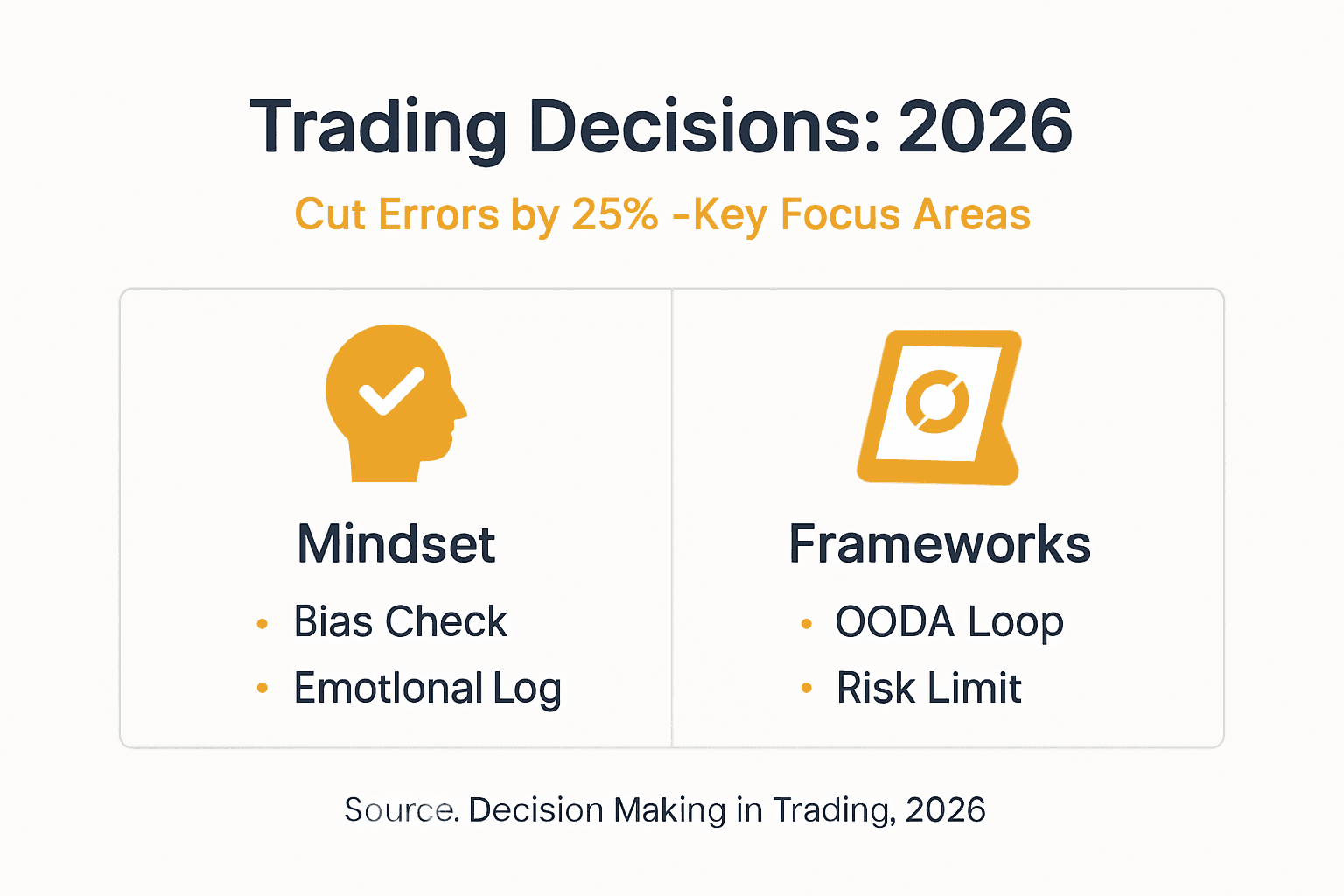
Fear and greed hijack rational analysis. Fear triggers premature exits on winning trades when minor pullbacks occur. Greed pushes you to chase rallies after missing initial entries, buying at tops. Emotional trading impulses increase premature trade exits by 25%, leading to costly losses. These reactions break discipline and prevent adherence to your strategy.
Recognizing emotional patterns is the first defense. Track your emotional state before, during, and after trades in a journal. Note instances of FOMO, revenge trading after losses, or euphoria after wins. Patterns emerge quickly, revealing your specific triggers.
Pro Tip: Set mandatory cooling-off periods after losses. Wait 30 minutes before entering another trade to let emotions settle and rational thinking return.
Common psychological traps to avoid:
- Confirmation bias: seeking only information that supports your position
- Recency bias: overweighting recent events in your analysis
- Anchoring: fixating on entry prices instead of current market conditions
- Herd mentality: following crowd behavior without independent analysis
Tools like emotional control training with TradingCoach help identify and manage these patterns. Awareness alone improves decision quality, but combining awareness with structured frameworks creates lasting behavior change.
Decision-Making Frameworks and Models for Trading
Structured frameworks transform vague intentions into repeatable processes. The OODA loop, developed by military strategist John Boyd, provides a four-step cycle: Observe, Orient, Decide, Act. You observe market conditions and price action. You orient by analyzing this data against your strategy criteria. You decide whether to enter, exit, or hold. You act by executing the trade.
This cycle repeats continuously, keeping you responsive without being reactive. 73% of successful professional traders use structured decision protocols combined with emotional control training. The OODA loop prevents impulsive entries by forcing conscious evaluation at each step.
Probabilistic thinking shifts your mindset from right versus wrong to probability management. Instead of predicting market direction, you assess likelihood and manage risk accordingly. A trade with 60% win probability still loses 40% of the time. This perspective reduces emotional attachment to individual outcomes and focuses attention on process quality.
| Framework | Best For | Key Benefit |
|---|---|---|
| OODA Loop | Fast-moving markets | Forces systematic evaluation before action |
| Probabilistic Thinking | Uncertain conditions | Manages expectations and reduces emotional swings |
| Decision Trees | Complex multi-factor scenarios | Maps outcomes and clarifies best paths |
| Checklists | Pre-trade validation | Ensures all criteria are met before entry |
Pro Tip: Choose frameworks matching your trading style. Day traders benefit from OODA's speed, while swing traders gain more from decision trees mapping multi-day scenarios.
Explore decision-making frameworks pricing page or try TradingCoach for decision frameworks to implement these models with guided support. Frameworks eliminate the mental burden of reinventing your process with every trade, freeing cognitive resources for higher-level analysis.
Risk Management Techniques in Decision Making
Risk management is not optional. It defines the boundary between sustainable trading and account destruction. Stop-loss orders cap maximum loss on every trade, removing the need for emotional decisions when prices move against you. Proper stop-loss orders reduce drawdowns significantly improving trade outcomes. Set stops based on technical levels or volatility, not arbitrary percentages.

Position sizing determines how much capital you risk per trade. The common 1-2% rule limits single-trade risk to a small account percentage, ensuring no single loss derails your strategy. Calculate position size by dividing risk amount by stop distance. If you risk $100 on a trade with a $2 stop, your position size is 50 shares.
Integrating risk controls into your decision process creates automatic guardrails. Before entering any trade, define your stop level and position size. If these parameters violate your rules, skip the trade regardless of setup quality. This discipline prevents the costly mistakes that stem from "just this once" thinking.
Essential risk management practices:
- Never enter a trade without a predefined stop-loss
- Keep position sizes consistent with your risk tolerance
- Adjust sizing based on setup quality and market conditions
- Review risk metrics weekly to identify creeping violations
- Use alerts to monitor stop distances in real time
Neglecting these controls leads to catastrophic losses during adverse market moves. The traders who survive and thrive are those who treat risk management as the foundation of every decision, not an afterthought.
Quantitative Evaluation of Trade Decisions and Performance
Data reveals truth that memory distorts. Quantitative evaluation means tracking every trade with objective metrics, then analyzing patterns to improve future decisions. Automated trading journals help identify and correct systematic mistakes for continuous improvement. Manual tracking fails because memory is selective, emphasizing wins and minimizing losses.
Backtesting applies your decision rules to historical data, revealing whether your strategy has edge. Test entry criteria, exit rules, and risk parameters across different market conditions. Patterns emerge showing which setups work and which drain capital. This evidence-based approach replaces hope with probability.
Systematic trade review follows these steps:
- Log every trade immediately with entry reason, stop, target, and emotional state
- Tag trades by setup type, market condition, and time of day
- Calculate win rate, average win, average loss, and profit factor monthly
- Identify your highest and lowest performing setups
- Adjust strategy by increasing focus on winners and eliminating consistent losers
| Metric | Before Analysis | After Analysis | Improvement |
|---|---|---|---|
| Win Rate | 48% | 56% | +8% |
| Avg Win/Loss Ratio | 1.3:1 | 1.8:1 | +38% |
| Monthly Return | 2.1% | 4.7% | +124% |
| Max Drawdown | 18% | 11% | -39% |
The automated TradeJournal by Novera handles logging and analysis automatically, surfacing insights you would miss manually. Regular quantitative review transforms trading from subjective art into measurable skill, where improvement compounds over time.
Common Misconceptions and Biases in Retail Trader Decisions
Myths sabotage progress. The first misconception is that predicting market direction drives success. Truth: consistent execution of a disciplined process beats prediction every time. Even a 55% win rate generates substantial returns with proper risk management. Obsessing over prediction creates analysis paralysis and prevents action.
The second myth suggests gut feeling guides best decisions. Intuition feels powerful because it operates instantly without conscious thought. But retail traders often have inconsistent outcomes due to emotional decision-making without structured frameworks. Gut feelings reflect recent experiences and emotional state, not statistical edge. Structure and emotional control consistently outperform instinct.
The third misconception treats risk management as secondary to setup identification. Traders hunt perfect entries while ignoring position sizing and stops. Reality: even mediocre setups become profitable with excellent risk control, while perfect setups destroy accounts with poor risk management. Risk technology prevents catastrophic losses that wipe out months of gains in minutes.
Debunking these myths requires examining your own beliefs:
- Do you spend more time analyzing entries than planning exits and risk?
- Do you override your rules when you feel strongly about a trade?
- Do you attribute losses to bad luck rather than process failures?
- Do you avoid journaling because it feels tedious?
Honest answers reveal where misconceptions control your behavior. Replace beliefs with evidence by tracking results and letting data guide improvements. The path from struggling trader to consistent performer requires confronting these uncomfortable truths and rebuilding your approach on proven principles.
Real-World Trading Decision Case Studies
A swing trader reduced losses by 40% over six months by implementing integrated decision-making methods. Previously, emotional reactions caused holding losing trades past stops, hoping for reversals. After adopting the OODA loop and mandatory trade journaling, patterns became visible. The trader realized loss aversion triggered stop violations specifically on trades entered after winning streaks.
This insight led to a new rule: after three consecutive wins, reduce position size by 50% on the next trade. The pattern broke immediately. Smaller positions removed the emotional weight that triggered irrational holding. Combined with automated stop-loss alerts, this psychological awareness and risk control transformed results.
Another case involved a day trader struggling with impulsive entries during high volatility. Integration of Novera's automated dashboard provided real-time emotional alerts when trading frequency exceeded predefined limits. The dashboard flagged revenge trading patterns after losses, giving the trader objective feedback in the moment.
Key factors in both success stories:
- Recognition of specific emotional triggers through journaling
- Implementation of rule-based responses to identified patterns
- Use of technology to enforce discipline in real time
- Regular quantitative review to measure improvement
- Adjustment of strategies based on performance data
These examples demonstrate that structured approaches work across trading styles and timeframes. The common thread is replacing reactive decisions with proactive systems that account for both psychology and risk.
Applying Structured Decision Making with Tech Tools
Modern technology removes friction from disciplined trading. Automated data analysis uncovers hidden biases you cannot spot manually. Dashboards track metrics like average hold time by outcome, revealing whether you cut winners short while holding losers long. This specific insight allows targeted correction.
Real-time monitoring of emotional triggers changes behavior in the moment. Set alerts when trade frequency spikes above your plan, signaling potential impulsive behavior. Receive notifications when daily loss limits approach, preventing the revenge trading that turns small losses into disasters.
Integration of technology supports disciplined adherence to strategies without constant willpower expenditure. Automation handles repetitive tasks like trade logging, position sizing calculations, and stop-loss placement. Your mental energy focuses on analysis and decision quality rather than administrative burden.
Pro Tip: Customize alert thresholds based on your specific patterns. If you tend toward overtrading after 10am, set a trade count alert at 9:45am to increase awareness during your danger window.
Practical technology applications:
- Automated trade import eliminates manual logging errors
- Pattern recognition algorithms identify your repeating mistakes
- Performance dashboards visualize progress toward goals
- Mobile alerts provide real-time discipline support
- AI analysis suggests specific improvements based on your data
The Novera trading platform combines these features in a single interface designed for retail traders. Technology does not replace skill, but it amplifies the impact of structured decision-making by making discipline easier to maintain consistently.
Conclusion: From Understanding to Consistent Trading Outcomes
Consistent trading results flow from mastering psychological awareness, applying structured frameworks, integrating risk management, and leveraging quantitative evaluation. No single element succeeds alone. Biases sabotage even the best strategies without awareness. Frameworks fail without risk controls to limit damage. Technology amplifies good processes but cannot fix fundamentally flawed approaches.
Your path forward requires honest assessment of current decision quality, implementation of specific improvements, and commitment to systematic review. Start by tracking emotional states and identifying your dominant biases. Choose a framework matching your style and apply it to every trade. Enforce risk rules without exception. Review performance weekly using objective metrics.
The traders who achieve lasting success are those who treat decision-making as a skill requiring deliberate practice and continuous refinement. Tools like Novera provide the infrastructure supporting this development, but ultimate responsibility remains with you. Begin today by implementing one concrete change from this guide.
Discover Novera Tools to Enhance Your Trading Decisions
Ready to transform your trading decisions from reactive to systematic? Novera offers a complete suite of tools designed specifically for retail traders seeking consistent outcomes. Our platform combines automated journaling, AI-powered analysis, and personalized coaching to address every aspect of decision-making covered in this guide.

Novera's TradeJournal automatically logs every trade and surfaces the patterns holding you back. TradeReviewAI for decision insights analyzes your performance data and suggests specific improvements targeting your unique challenges. TradingCoach to master emotional control provides personalized guidance helping you recognize and overcome psychological barriers.
These tools work together, creating a comprehensive system supporting disciplined decision-making and continuous improvement. Explore our platform to see how technology can accelerate your journey from inconsistent results to reliable trading performance.
FAQ
What are the most common cognitive biases affecting traders?
Overconfidence bias leads traders to take excessive risks and trade too frequently, believing they can predict markets better than evidence supports. Loss aversion causes holding losing positions past stop levels, hoping to avoid realizing losses. Both biases disrupt strategy adherence and create inconsistent results that could be avoided with structured decision protocols.
How can risk management improve trading decisions?
Risk management limits maximum loss per trade through stop-loss orders and position sizing, preventing catastrophic drawdowns that destroy accounts. It aligns trade size with your risk tolerance and account size, ensuring survival during losing streaks. Proper risk controls reduce emotional pressure during adverse price movement, allowing rational decision-making when it matters most.
What decision-making frameworks are best for retail traders?
The OODA loop excels in fast-moving markets by enforcing systematic observation, orientation, decision, and action cycles that prevent impulsive trades. Probabilistic thinking helps traders manage uncertainty by focusing on edge and process quality rather than individual outcomes. Both frameworks reduce emotional decision-making and improve consistency across different market conditions and trading styles.
How do technology tools like Novera support trading decisions?
Novera platform automates trade data analysis, revealing hidden patterns and biases impossible to spot manually in real time. The system alerts traders when behavior deviates from their plan, such as excessive trade frequency or position sizes exceeding risk limits. This combination of automated analysis and real-time feedback enforces discipline without constant willpower, making consistent execution significantly easier.