
Many traders assume effective trading decisions stem from reacting quickly to signals. Modern AI systems analyze thousands of data points continuously and adapt strategies dynamically. This guide reveals how artificial intelligence and hybrid decision frameworks transform trading consistency and deliver measurably better returns.
Table of Contents
- Foundations of Decision Making in Automated Trading
- Beyond Signal Generation: Decision Intelligence in Trading
- Hybrid Approaches: Augmenting Human Decisions with AI
- Behavioral Factors in Automated Decision-Making
- Correcting Common Misconceptions in Trading Decisions
- Advanced AI Models Enhancing Trading Decisions
- Practical Frameworks for Structured Trading Decision Making
- Unlock Smarter Trading Decisions with Novera
- Frequently Asked Questions
Key Takeaways
| Point | Details |
|---|---|
| AI enhances decisions beyond signals | Machine learning evaluates multidimensional market data in real time for adaptive strategies. |
| Hybrid human-AI trading boosts ROI | Combining human judgment with AI systems yields 3-5% higher returns than pure automation or manual trading. |
| Behavioral insights increase accuracy | Sentiment analysis and explainable AI methods improve directional prediction and trader confidence. |
| Advanced models optimize risk dynamically | Deep reinforcement learning algorithms adapt strategies continuously to changing market regimes. |
Foundations of Decision Making in Automated Trading
Artificial intelligence has redefined how traders approach market analysis and execution. Traditional rule-based systems process predefined conditions, but modern AI trading strategies employ machine learning and deep learning to evaluate historical and real-time data simultaneously. This capability enables decisions far beyond simple technical signals.
Adaptive algorithms adjust continuously as market conditions shift. Where static bots follow rigid instructions, AI-powered systems recognize regime changes and recalibrate parameters automatically. You gain responsiveness that matches market volatility without manual intervention.
Machine learning models integrate diverse data types:
- Price action and volume patterns across multiple timeframes
- Order flow imbalances indicating institutional activity
- Sentiment derived from news feeds and social media streams
- Macroeconomic indicators and correlation matrices
This multidimensional approach creates a comprehensive decision foundation. AI processes information faster and more thoroughly than any human trader could manage independently. The result is trading logic that evolves with markets rather than fighting against changing dynamics.
"Effective automated trading relies on continuous learning loops that incorporate new market information and refine decision models in real time."
Platforms like trading coaching services help you understand how these AI foundations apply to your specific strategy. Building awareness of machine learning principles empowers better collaboration between your judgment and automated systems.
Beyond Signal Generation: Decision Intelligence in Trading
Signal generation represents just one component of sophisticated trading systems. Decision intelligence frameworks evaluate context before executing trades. These systems consider market regimes, liquidity conditions, and behavioral data inputs simultaneously.
Context-aware models adjust trade confidence and position sizing dynamically. When volatility spikes or liquidity thins, the system scales exposure accordingly. You avoid the binary "all or nothing" approach that plagues simpler signal-based bots.
Decision maps enable nuanced execution strategies:
- Evaluate multiple timeframes to confirm trend alignment
- Assess correlation risk across portfolio holdings
- Calculate optimal entry timing based on order book depth
- Determine position size using volatility-adjusted risk parameters
- Set dynamic stop loss levels that adapt to intraday volatility
AI systems evaluate risk asymmetry before committing capital. They identify scenarios where potential losses outweigh gains even when signals appear bullish. This preemptive risk assessment prevents costly mistakes that traditional indicators miss.
Liquidity analysis ensures trades execute at favorable prices. Algorithms check spread width, order book depth, and recent transaction volume. Large positions split across multiple orders to minimize market impact and slippage.
Exploring pricing plans for advanced trading tools reveals how decision intelligence platforms package these capabilities for retail traders. Technology once exclusive to institutional desks now empowers individual market participants with similar analytical depth.
Hybrid Approaches: Augmenting Human Decisions with AI
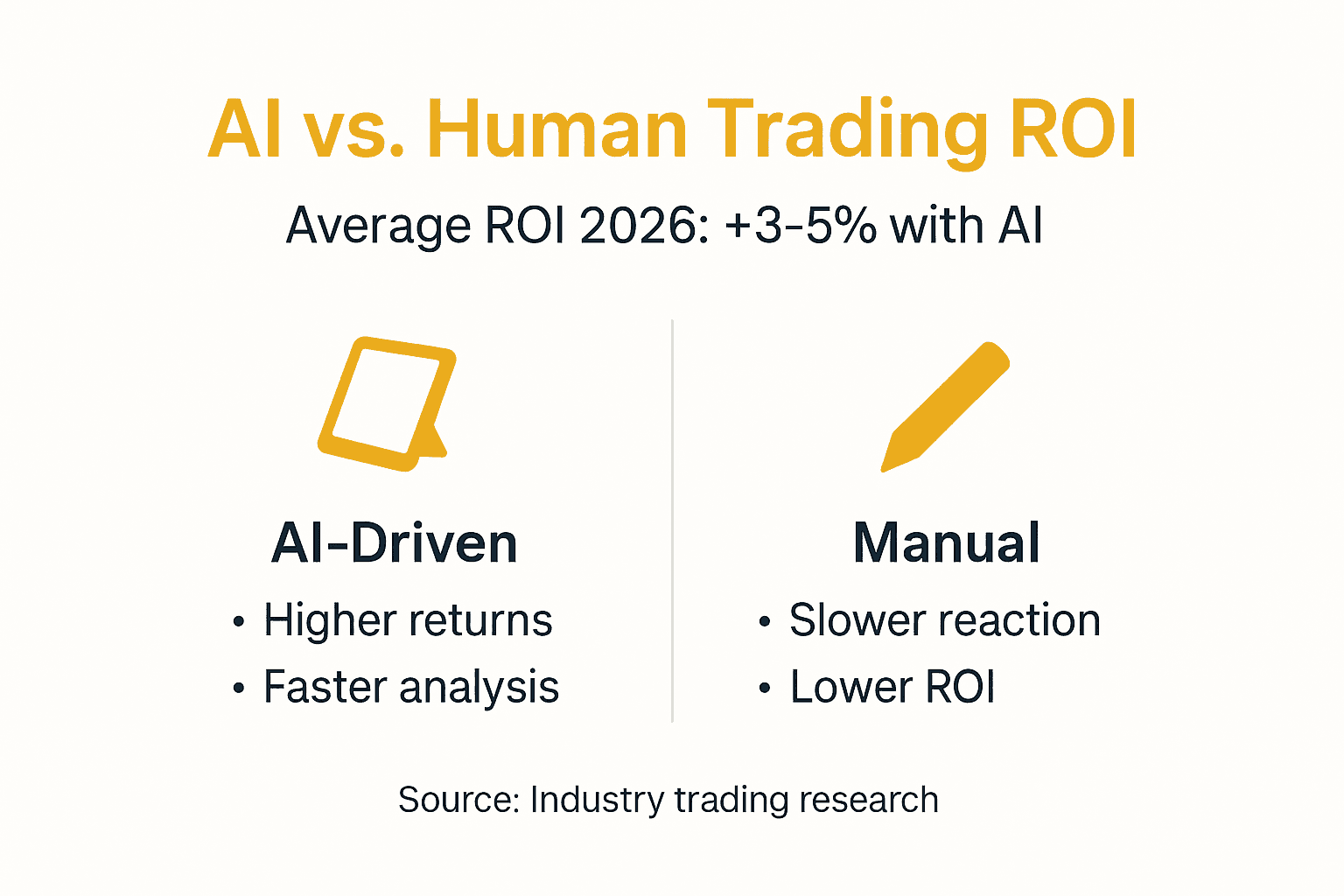
Combining human insight with artificial intelligence produces superior outcomes compared to either approach alone. Research shows hybrid systems outperform AI-only or human-only methods by delivering 3-5% higher ROI across diverse market conditions. This performance edge stems from complementary strengths.

Humans excel at recognizing unprecedented market events and incorporating ethical considerations. You adapt decision frameworks when geopolitical shocks or regulatory changes render historical patterns irrelevant. AI provides rapid, data-driven risk adjustments and precision execution that emotional traders struggle to maintain.
Key advantages of hybrid decision making:
- AI processes vast datasets to identify subtle patterns humans miss
- Human judgment applies contextual understanding during black swan events
- Combined approach improves transparency as traders review AI reasoning
- Strategic flexibility allows intervention when market structure changes fundamentally
Effective collaboration requires understanding AI outputs rather than blindly following recommendations. You evaluate the logic behind suggested trades and override decisions when your market knowledge identifies flaws in the model's assumptions. This active partnership builds better long-term results.
Pro Tip: Document every instance where you override AI recommendations and track outcomes. This feedback loop helps refine both your judgment and the system's parameters over time.
Trading coaching services teach you how to interpret AI signals within your broader strategy. Learning to question and validate automated suggestions strengthens decision quality. Tools like AI trade review platforms provide post-trade analysis that highlights where human or AI decisions drove performance.
Check pricing plans to find technology that supports your hybrid approach. The right infrastructure makes collaboration between your expertise and automated intelligence seamless and productive.
Behavioral Factors in Automated Decision-Making
Sentiment analysis enables trading systems to respond dynamically to market psychology shifts. AI models parse news sentiment, social media trends, and options market positioning to gauge crowd emotion. This behavioral data complements traditional technical analysis for more complete decision inputs.
Explainable AI methods unlock understanding of automated logic and build trader confidence. When you see exactly which factors drove a trade recommendation, you trust the system more and identify improvement opportunities. Integration of explainable AI (XAI) methods facilitates trader trust by clarifying decision factors and supporting ongoing system refinement.
Behavioral metrics contribute to directional accuracy improvements. Systems incorporating sentiment alongside price data achieve prediction rates exceeding 90% in certain market conditions. Fear and greed indicators help time entries and exits as crowd psychology reaches extremes.
Transparency encourages adherence to automated strategies. Traders abandon systems they don't understand during drawdown periods. When you comprehend the reasoning behind each decision, you maintain discipline through normal performance fluctuations. This consistency compounds into better long-term returns.
Pro Tip: Review your emotional state before manually intervening in automated trades. Strong emotions often signal that behavioral biases are clouding judgment rather than genuine strategy flaws.
Platforms like Novera integrate behavioral tracking into trade journals. You identify patterns where emotions override sound analysis. Awareness of these tendencies helps you distinguish valid intuition from counterproductive impulses.
Understanding explainable AI in trading frameworks empowers you to demand transparency from any automated system. Never rely on black box algorithms that can't articulate their decision process clearly.
Correcting Common Misconceptions in Trading Decisions
Many people believe algorithmic trading equals ultra-high-frequency execution competing on milliseconds. This narrow view misses how retail and institutional traders actually deploy automation. Algorithmic trading is not solely about execution speed; data science expertise in AI models understanding sentiment and risk drives success more than latency.
Retail algorithmic trading has grown substantially with accessible platforms offering diverse adaptive strategies. You don't need proprietary infrastructure to benefit from automated decision frameworks. Cloud-based solutions democratize technology previously limited to well-capitalized firms.
Modern algorithms commonly employ long-term risk models rather than focusing exclusively on high-frequency signals:
- Position sizing based on portfolio volatility and correlation
- Multi-day swing strategies optimized through machine learning
- Fundamental factor integration for equity selection
- Options strategies balancing theta decay against gamma risk
| Misconception | Reality |
|---|---|
| Algorithms just execute faster | AI analyzes sentiment, correlation, and regime changes for strategic advantage |
| Only institutions benefit | Retail platforms now offer institutional-grade analytics and automation |
| Systems are rigid and inflexible | Machine learning models adapt continuously to market evolution |
| Human input becomes irrelevant | Hybrid approaches combining human judgment with AI produce best results |
Understanding these realities helps you evaluate technology objectively. Explore automated trading insights to see how adaptive systems apply across different market conditions and timeframes.
Educating yourself on algorithmic trading misconceptions prevents costly misunderstandings. AI-enhanced trading focuses on better decisions, not just faster execution.
Advanced AI Models Enhancing Trading Decisions
Deep reinforcement learning represents a significant advancement in automated trading intelligence. These models learn optimal strategies through trial and error within simulated market environments. Proximal Policy Optimization outperforms other approaches by optimizing cumulative returns and Sharpe ratios simultaneously.
Reinforcement learning adapts trading strategies in real time as market microstructure changes. The system recognizes when volatility regimes shift or correlation patterns break down. You gain responsiveness that static models cannot match.
Sharpe ratio improvements indicate better risk management across different AI architectures. Higher risk-adjusted returns mean you achieve similar gains with lower drawdowns. This stability proves especially valuable during market stress periods.
| Model Type | Cumulative Return | Sharpe Ratio | Best Conditions |
|---|---|---|---|
| Proximal Policy Optimization | Highest | 1.85 | Trending markets with moderate volatility |
| Deep Q-Network | Moderate | 1.42 | Range-bound conditions with clear support/resistance |
| Actor-Critic | Good | 1.67 | High volatility environments requiring rapid adaptation |
| Traditional Moving Average | Baseline | 0.98 | Stable trends without regime changes |
Different AI models demonstrate strengths depending on prevailing market conditions. Sophisticated traders deploy ensemble approaches that blend multiple algorithms. This diversification reduces reliance on any single model's assumptions.
Tools like AI trade review platforms help you understand which models perform best in your specific markets. Analyzing past performance across various AI approaches reveals optimization opportunities.
Studying reinforcement learning in trading research papers keeps you current on technological advances. Academic literature often previews capabilities that reach commercial platforms within months.
Practical Frameworks for Structured Trading Decision Making
Implementing decision intelligence frameworks requires systematic integration of data inputs with behavioral insights. Start by defining your information hierarchy. Determine which signals carry primary weight and which serve as confirmation filters.
Stepwise risk assessment complements AI trade analysis:
- Quantify maximum acceptable loss per trade and per day
- Calculate position size using volatility-adjusted risk parameters
- Evaluate correlation exposure across existing portfolio holdings
- Set profit targets based on historical volatility and support/resistance levels
- Define conditions triggering early exit or position adjustment
Continuous learning loops refine models by incorporating trader feedback. Document trades where outcomes diverged from expectations. Analyze whether the AI model, your judgment, or external factors caused the variance. This process identifies improvement opportunities in both automated and manual decision components.
Best practices blend human judgment with AI for optimal decisions. Use automation for rapid data processing and emotion-free execution. Apply human insight for context that machines cannot easily quantify, such as regulatory changes or management credibility.
Pro Tip: Create decision checklists that combine AI outputs with your qualitative assessment criteria. This structured approach prevents overlooking important factors during high-pressure trading moments.
Platforms offering structured trading frameworks provide templates and guidance for implementing these systems. Professional coaching accelerates your learning curve by highlighting common pitfalls and optimization strategies.
Successful decision frameworks evolve as you gain experience and markets change. Regular review ensures your process remains aligned with current conditions rather than fighting outdated patterns.
Unlock Smarter Trading Decisions with Novera
You've learned how AI and hybrid decision frameworks transform trading consistency. Now implement these strategies with tools designed for modern traders. Novera offers AI-driven trade journal capabilities and analytics dashboards that automatically evaluate your decisions and identify improvement patterns.
Personalized trading coaching integrates hybrid decision strategies tailored to your specific markets and risk tolerance. Work with experts who understand both algorithmic systems and human psychology. The AI-powered trade review tool provides data-driven insights on every position, helping you refine entry timing, position sizing, and exit discipline. Transform confusion into clarity with structured frameworks that blend your expertise with cutting-edge technology.
Frequently Asked Questions
What are the key advantages of AI in trading decisions?
AI processes thousands of data points simultaneously and identifies subtle patterns humans miss. Machine learning models adapt continuously to changing market regimes without emotional interference. You gain speed, consistency, and analytical depth that manual analysis cannot match.
How can traders balance AI recommendations with their own judgment?
Use AI for rapid data processing and pattern recognition while applying human insight to unprecedented events and ethical considerations. Document instances where you override AI suggestions and track outcomes. This feedback loop refines both your judgment and the system's parameters over time.
Which behavioral factors most impact automated trading accuracy?
Sentiment analysis from news and social media provides valuable crowd psychology indicators. Fear and greed extremes often signal reversal opportunities that price data alone misses. Explainable AI methods that clarify decision logic also improve accuracy by building trader confidence and adherence to strategies.
When should human intervention override an AI trading system?
Intervene during unprecedented geopolitical events or regulatory changes that lack historical precedent in training data. Override recommendations when you identify fundamental shifts in market structure or company-specific information the model cannot access. Always maintain final decision authority rather than blindly following automation.
Explore trading coaching resources to deepen your understanding of when and how to collaborate most effectively with AI systems.